It's the night of December 25. The wrapping paper is in a bag by the door, and on the kitchen table sits a candle holder with seven empty spots. Tomorrow it starts. You're trying to figure out how to explain seven candles, seven words in Swahili, and seven nights to someone who is four and mostly wants to know if there will be cake.
You don't need to explain all of it tonight. Kwanzaa traditions work well with young children because they come in small pieces: one candle, one word, one thing to do. Your child doesn't have to understand the whole week on day one. They only have to show up for tonight's candle.
Kwanzaa in a sentence or two
Kwanzaa is a yearly celebration of African-American culture that runs from December 26 to January 1, with a big shared feast called Karamu on December 31 (National Geographic Kids). The name means "first fruits" in Swahili (National Geographic Kids). It is not a religious holiday, so families of any background can celebrate it and learn about it (Charlottesville Family). It dates back to 1966 (ParentsTogether).
For a preschooler, you can say it even more simply: "For seven nights, we light a candle and talk about one good idea. Then we have a big dinner together."
Start with the candles
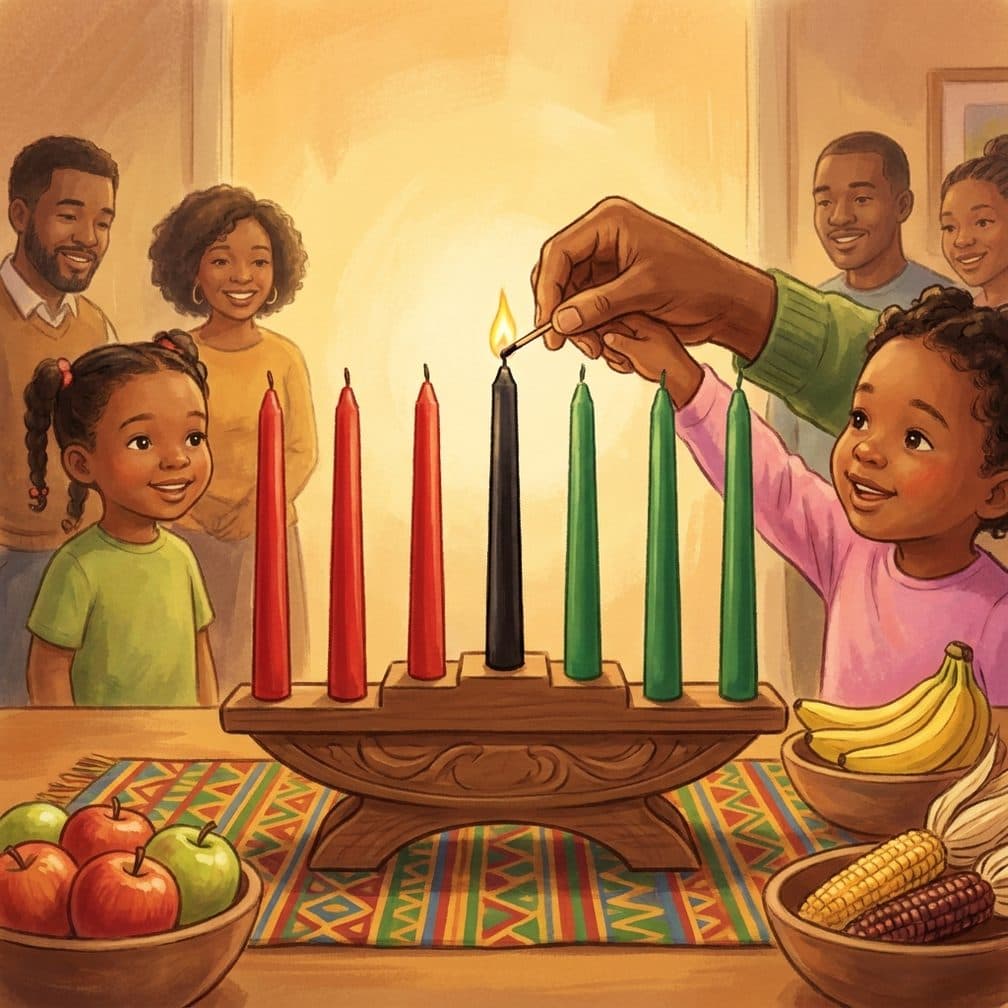
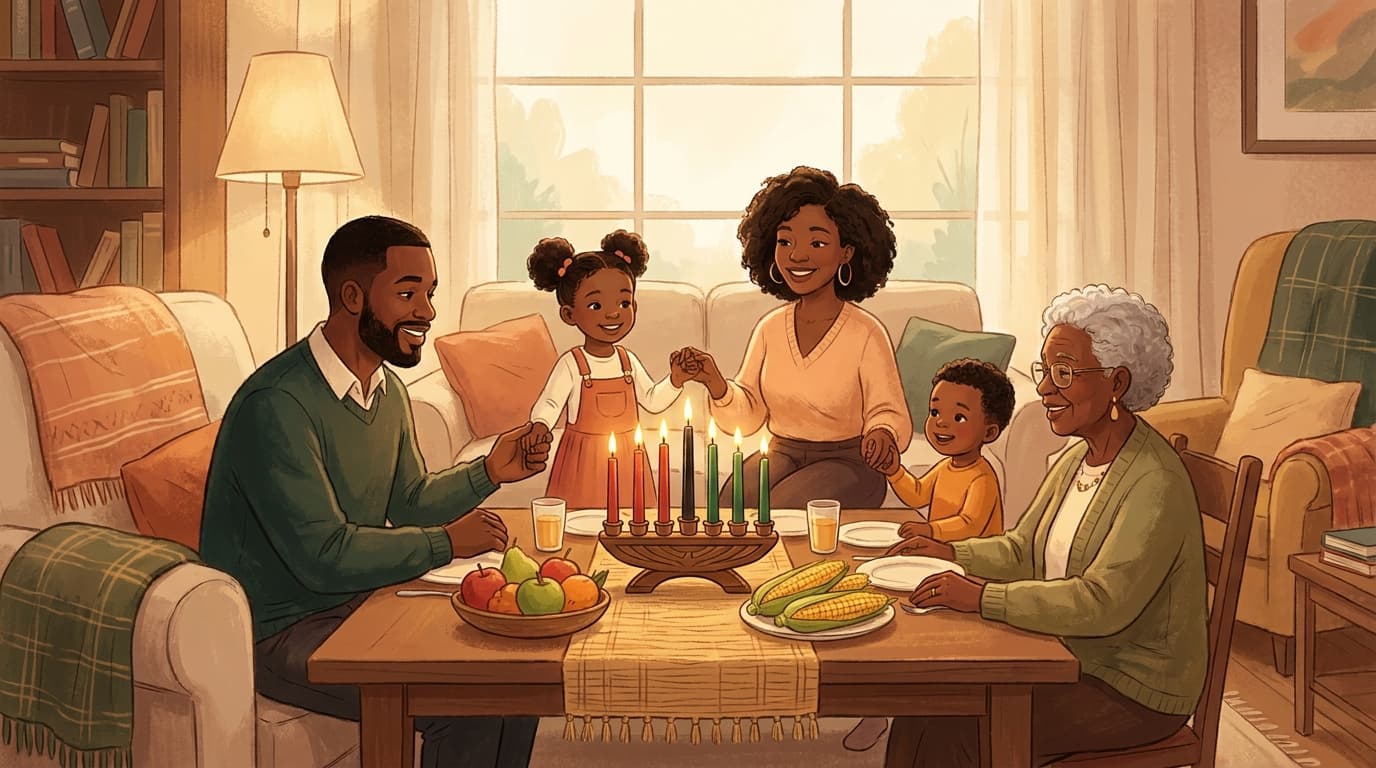
The kinara is the easiest way in. It's the candle holder, and each day one candle is lit for one of seven principles (PBS KIDS for Parents). There are seven candles: one black, three red and three green. The black candle sits in the middle and stands for unity among people of African descent (National Geographic Kids).
Small children like a job, so give them one. They can place the candle in the kinara, or "light" it by pointing and saying the word for the night while an adult handles the flame. If real candles don't suit your house this year, a paper kinara works too. Your child colors seven paper candles and glues one on each night.
The seven principles, in words a child can hold
Here are the seven principles, with a kid-sized way to say each (National Geographic Kids):
- Umoja: unity. "We stick together."
- Kujichagulia: self-determination. "I can help myself do hard things."
- Ujima: collective work and responsibility. "We work as a team."
- Ujamaa: cooperative economics. "We share and help each other's work grow."
- Nia: purpose. "I have something good to do."
- Kuumba: creativity. "I can make things."
- Imani: faith. "We believe in each other."
If you're nervous about pronunciation, you're not the only one. PBS gives Umoja as oo-MOH-jah (PBS KIDS for Parents), and Charlottesville Family gives Kujichagulia as koo-jee-cha-goo-LEE-ah (Charlottesville Family). For the others, look them up together and practice out loud. A grown-up getting a word slightly wrong and trying again is not a bad thing for a child to see.
One easy activity for each night
Keep each night short. Light the candle, say the word, do one small thing. Ten minutes is plenty.
Night 1: Umoja (unity)
Pile everyone's hands in the middle of the table, then lift them together. Then go around and have each person say one thing they like about being in this family. A two-year-old's answer might be "the dog." That counts.
Night 2: Kujichagulia (self-determination)
Help your child pick one small goal and talk about how to reach it (Charlottesville Family). Keep it tiny and real: putting on their own socks, or pouring their own water. Tomorrow, notice out loud if they did it.
Night 3: Ujima (teamwork)
Pick a family project, like tidying the living room together, and talk about why teamwork matters (Charlottesville Family). Give your child a job only they do, like being in charge of all the pillows.
Night 4: Ujamaa (sharing and supporting)
One suggestion is to find Black-owned businesses in your community and spread the word (ParentsTogether). With a young child, make it concrete. Visit one bakery or bookstore together, or let them help choose something to buy. On the way home, ask, "Who should we tell about this place?"
Night 5: Nia (purpose)
Ask, "What do you like helping with?" Write the answer on a slip of paper and tape it near the kinara. For older kids, you can stretch it: "What do you want to get really good at?"
Night 6: Kuumba (creativity)
This is often the Karamu night, so make something for the feast. Kids can decorate placemats for the table (Macaroni KID), or make a handprint kinara with painted palms and fingers and yellow dots for flames. Another option is a cardboard kinara with candles painted red, green and black (Macaroni KID). A regular weekend art time is a nice way to keep Kuumba going after the week ends.
Night 7: Imani (faith)
Go around the table and finish this sentence for someone else: "I believe you can..." Gifts are part of Kwanzaa too (National Geographic Kids), and they can be small and homemade. A drawing from Night 6 makes a fine present for a grandparent.
A ritual even a toddler can join
The unity cup is short and easy to repeat. An adult pours a little water or juice on the ground to remember ancestors. Then the cup is passed around, everyone takes a sip, and everyone says "harambee," which means "let's pull together," seven times (National Geographic Kids). Families do this in different ways, so adapt it to fit yours. Kids tend to enjoy the counting and the chance to say a big word loudly.
What this week can and can't do
Seven nights won't make a four-year-old an expert on Kwanzaa, and they don't need to. Some nights your child will be into it. Other nights they'll blow at the candle, ask for a snack and wander off. That's fine. Light the candle anyway and try again tomorrow.
What carries over is the words. Kwanzaa is seven days, but its lessons can last the whole year. When a principle shows up in an ordinary moment, name it:
- "That was Ujima. We all helped clean up."
- "You put your shoes on all by yourself. That's Kujichagulia."
- "You made that from a box? Kuumba."
A small takeaway
You don't need a perfect setup on December 26. You need one candle, one word, and a few minutes at the table. Start there and see which nights your child wants to repeat. Which of the seven do you think your kid will pick as their favorite?
A story to read on the seventh night
Holiday Hero: Kwanzaa is a story for ages 2 to 12 in which your child is the hero of the celebration. You can also create a personalized book with your child in the story and choose from illustration styles like Watercolor, Color Pencil, Gouache or Comic Book.
The digital book is $11.99 and is ready in hours, which helps if Kwanzaa is already close. A softcover printed copy is $39 and ships in 3 to 5 days. A hardcover is $59 and ships in 5 to 7 days. Shipping is free in the US, and a person on our team checks every book before it is delivered.